Third Floor
The Legend of William OhThird Floor is a brutal and unstable region of The Tower where environmental hazards, restricted movement, and political violence make every route a calculation of survival. Its ashlands are hot, caustic, and dim beneath a blood-red sun, yet the floor also contains cities, Strongholds, Key Sites, and routes upward. The result is a setting in which advancement is never merely a matter of reaching the next door: climbers must endure Miasma Acclimation, secure water, read the darkness, and decide whether the floor is best crossed, occupied, or exploited.
Physical Environment
Third Floor announces itself through bodily shock. When Will enters, hot air slams into his face, ash crunches beneath his feet, and caustic fumes thicken the air while a dim, blood-red sun hangs overhead. The System immediately imposes three days of Miasma Acclimation, making the floor dangerous before any monster or hostile Climber appears. The atmosphere is not decorative background; it is an active pressure that limits how long an outsider can function and turns acclimation into a prerequisite for movement.
The floor’s geography is equally hostile to ordinary assumptions. Earlier in The Tower, Will and Loth discover what appears to be a mountain peak, only to learn that it is a floating mountain suspended in the sky, separated from surrounding land by sheer drops and open air. Their route is therefore governed by discontinuity rather than a dependable landscape: a climb can end at a cliff, and the idea of reaching “the ground” itself becomes uncertain. On Third Floor, verticality is not simply elevation but a system of exclusion, cutting travelers off from alternatives and making every accessible path strategically important.
The sun creates a further distortion. Will repeatedly finds its movement unnatural, while darkness later closes around a Stronghold until only small pools of light remain at the city’s edge, maintained by man-sized beacons burning on the walls. One patch of shadow at the base of the wall offers a possible approach: the top is illuminated, but an enterprising climber can reach the darkness below and begin climbing without being seen. Light and shadow thus function as tactical resources, determining who can enter a defended settlement and who remains exposed.
Survival and Routes Upward
Third Floor’s principal strategic problem is water. Loth proposes finding a source so that the group can remain in one place, camp within sight of a Key Site, and grind experience while waiting out Miasma Acclimation. Once acclimated, they could join a bus heading to Fourth Floor and bypass the worst of the conflict. Will regards the plan as an audacious attempt to cross the entire floor without engaging its dominant dangers, but Loth calculates that it offers roughly the same odds as sneaking past a determined search party of high-level Climbers, with the added benefit of gaining levels rather than dying while in motion.
This plan reveals how Third Floor converts ordinary necessities into strategic leverage. Water provides a fixed base; the Key Site provides access to experience; acclimation determines when the travelers can safely act; and the bus offers a controlled transition upward. The floor therefore contains a narrow economy of time, shelter, experience, and concealment. A party that cannot secure those resources is forced into exposed travel, while a party that can secure them may transform a seemingly impossible environment into a temporary training ground.
The environment remains punishing even during relatively calm travel. Will and his companions proceed at a relaxed but cautious pace through the brutal landscape, with Will struggling in equipment that makes him three inches taller than usual. The small inconvenience of clomping in unfamiliar gear sits against the larger danger of ash and heat, showing how survival on Third Floor is experienced through constant bodily adjustment as much as through dramatic combat.
Cities, Strongholds, and Extraction
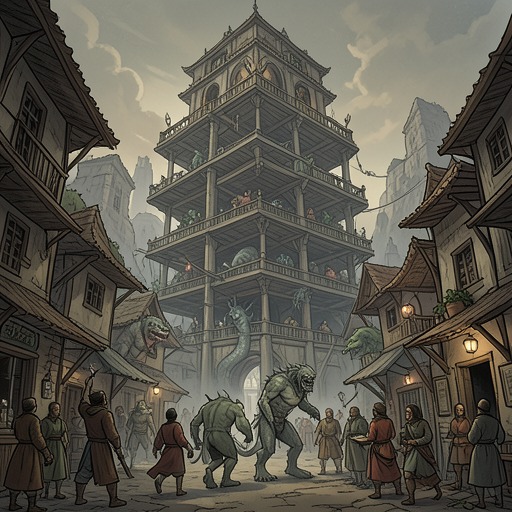
Oilton represents Third Floor’s modest but strategically valuable civilization. Mark Wyrd studies the city from a mount and regards its name as an apt joke for a place that produces oil from The Tower’s inexhaustible landscape. He had imagined his first Lordship as something grander: perhaps a hostile wilderness on Eleventh Floor where civilization would be established through struggle, or a gleaming golden city. Oilton instead is a small oil city on the meager Third Floor, neither a frontier of heroic scale nor a river-spanning center of civilization like the one on Fifth Floor.
That contrast makes Oilton significant. It is not presented as an idealized settlement but as a working foothold built around extraction, a quaint city whose value lies in what the floor can yield rather than in architectural grandeur. Its existence proves that Third Floor can support organized life, yet its dependence on oil also exposes the thinness of that order. Civilization here is practical, provisional, and tied to the exploitation of an apparently inexhaustible environment.
Coalton provides another point of contact with the floor’s wider routes. It is the closest city to the place where Steve arrives, and travel between the nearby Key Site and Coalton is short enough that Steve expects his work healing passing Parties to be profitable. Rumors of attacked buses and Oilton’s silence soon disturb that expectation. The connection between Key Site, city, and upward transport is therefore vulnerable: when buses are attacked or Oilton goes quiet, the floor’s network of movement and refuge begins to fail.
Strongholds are similarly both destinations and traps. Loth expects hostile forces to concentrate their search on the Stronghold to the east and predicts that they will try to block the approach. The group consequently camps on the opposite side of the hill, resting and drinking while observing the sun’s passage, then waits for darkness to provide a concealed route toward the wall. The Stronghold is not merely a safe city on a map; it is a contested threshold whose defenses, lighting, and surrounding terrain decide whether entry is possible.
Violence and Cosmic Disorder
The floor’s violence is inseparable from its environment. During a confrontation, a Sword Bandit is struck by a shot that opens a coin-sized hole in his chest before he topples into the ash. Will then sees Loth badly burned, his body reduced to scar tissue and fresh burns fused with his clothes and Relics, much of his scales burned away. Even after this ordeal, Loth reports reaching level fifteen before collapsing into the ash. The scene joins advancement to mutilation: experience is gained, but the floor exacts a visible bodily price.
Third Floor’s greatest disturbance is not caused by Climbers at all. In Granesh’s divine realm, a seemingly idyllic pond is revealed to lead to the sky of Third Floor, where the crimson sun circles the world. When Granesh finally catches the sun on barbed ox horns, the sun stops. William Oh tears it free, sacrificing his left arm as it chars and his wings burst into flame, then falls from the sky and is nursed back to health by the charwood nymphs of the ashlands. Without William Oh, the sun would remain overhead, growing hotter until no life survived on Third Floor. The floor’s central natural law is therefore exposed as vulnerable to divine interference, and its continued habitability depends on a desperate act of rescue.
This episode gives the setting a scale beyond local survival. The ashlands are at once a place where a wounded Climber collapses after combat and a world whose entire ecology can be destroyed by a god’s fishing accident. Third Floor’s danger moves between intimate and cosmic registers: a coin-sized wound, burned scales, three days of acclimation, and the possible extinction of all life belong to the same environment. Its decisive significance lies in that instability. Third Floor is not merely another step upward in The Tower, but a threshold where geography, infrastructure, violence, and the workings of the sky can all become existential threats.
Thresholds, Entrapment, and the Floor’s Larger Meaning
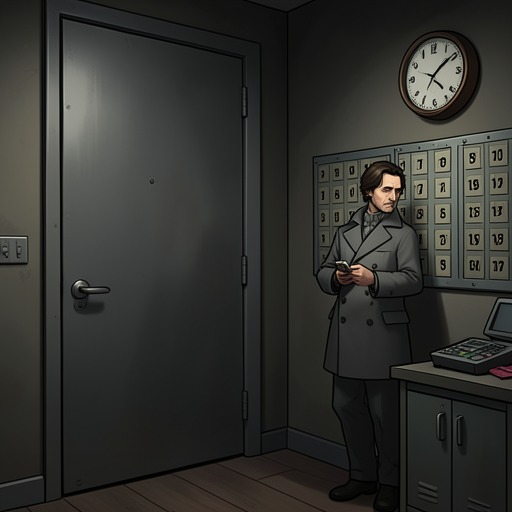
Third Floor belongs to a wider architecture of thresholds in The Tower, where movement is never guaranteed merely because a doorway exists. In the Class Creation Room, Will is trapped in a plain white room containing three Altars and no exit, a featureless cube from which previous Aspirants have been unable to escape even with Relic weapons supplied by high-level Climbers. Later, when he accepts a new passage outside Leon’s shop, the doorway appears identical to the one that imprisoned him for two days, transforming upward movement into a reminder of how easily access can become confinement. Third Floor extends this logic into the landscape: the floating mountain’s sheer drops, the ice cavern’s concealed spawning ground, and the Stronghold’s shadowed wall all make passage conditional on recognizing the space’s real structure. The floor is therefore both a physical region and a control system, sorting travelers through acclimation, terrain, darkness, hostile searches, and scarce routes. Its ashlands can support cities, experience-grinding, healing work, and upward transport, but every convenience remains exposed to interruption. That tension explains why Third Floor feels less like a stage on a straightforward ascent than a precarious world balanced between habitation and collapse: its people build footholds in an environment that can isolate a mountain in the sky, hide an entire ice network beneath a trail, extinguish a city’s communications, or leave the sun fixed overhead until all life dies.